
Running a business in the UAE used to mean zero taxes. Those days are gone. The UAE now has VAT, Corporate Tax, and Excise Tax. If you own a business here, you need to understand all three. Miss a deadline and you pay a fine. Get it wrong and the Federal Tax Authority (FTA) comes knocking.
This guide covers everything. We explain each tax in plain English. We tell you who must register, how much to pay, and when to file. We also tell you how to stay out of trouble.
Whether you run a small shop in Dubai or a large company in Abu Dhabi, this guide is for you.
Quick Answer: What Taxes Apply to UAE Businesses?
Here is a fast summary before we go deep:
• VAT (Value Added Tax): 5% on most goods and services. Mandatory registration if your revenue exceeds AED 375,000 per year.
• Corporate Tax: 0% on profits up to AED 375,000. 9% on profits above that. Applies from June 1, 2023.
• Excise Tax: 50% to 100% on specific harmful products like tobacco and energy drinks.
• Personal Income Tax: Zero. The UAE does not tax personal salaries or wages.
Now let us go through each one in detail.
Part 1: VAT in the UAE
What Is VAT?
VAT stands for Value Added Tax. The UAE introduced it on January 1, 2018. The rate is 5%. This is one of the lowest VAT rates in the world.
VAT is a tax on consumption. When your business sells something, you charge 5% on top of the price. You collect that money from the customer and pass it on to the FTA. It is not your money. You are just collecting it on behalf of the government.

Who Must Register for VAT?
You must register for VAT if your taxable supplies exceed AED 375,000 in the last 12 months or will exceed it in the next 30 days. This is called mandatory registration.
You can choose to register voluntarily if your supplies exceed AED 187,500 but are below AED 375,000. Voluntary registration makes sense if most of your customers are VAT-registered businesses, because it lets you reclaim VAT on your purchases.
To register, go to the FTA website at tax.gov.ae. You register through the EmaraTax portal. The process is fully online.
What Is VAT Applied To?
Most goods and services in the UAE have 5% VAT. But there are exceptions. Some are zero-rated. Some are exempt.
Zero-Rated Supplies (0% VAT)
Zero-rated means VAT applies at 0%. You still charge VAT, but at zero. You can still reclaim VAT on your costs. Zero-rated supplies include:
• Exports of goods outside the UAE
• International transport services
• Certain healthcare services and medicines
• Certain educational services
• Residential property (first supply)
• Precious metals like gold and silver for investment
Exempt Supplies (No VAT)
Exempt means no VAT at all. You do not charge VAT. But you also cannot reclaim VAT on related costs. Exempt supplies include:
• Financial services (in most cases)
• Residential property (subsequent supply)
• Bare land
• Local passenger transport
How to File VAT Returns
VAT returns are filed quarterly for most businesses. Some businesses file monthly. The return is due within 28 days after the end of your tax period.
For example, if your tax period ends on March 31, your return is due by April 28. File late and the FTA charges a penalty of AED 1,000 for the first time. Repeat offenders pay AED 2,000.
The return is filed on the EmaraTax portal. You report your output tax (VAT collected from customers) and input tax (VAT paid on purchases). The difference is what you owe the FTA. If you paid more VAT than you collected, the FTA owes you a refund.
VAT Penalties to Know
The FTA takes compliance seriously. Common penalties include:
• Late registration: AED 20,000
• Late filing: AED 1,000 first time, AED 2,000 for repeat
• Late payment: 2% of unpaid tax immediately, then 4% after 7 days
• Incorrect return: AED 3,000 first time
Avoid all of this by keeping clean records and filing on time. A good accounting firm handles this for you.
Part 2: Corporate Tax in the UAE

What Is Corporate Tax?
Corporate Tax (CT) is a tax on business profits. The UAE introduced it on June 1, 2023. This was a big change. Before 2023, most businesses in the UAE paid no tax on profits.
The UAE introduced Corporate Tax to align with international standards. It also joined the global minimum tax agreement run by the OECD. This means large multinationals cannot use the UAE to avoid paying taxes elsewhere.
Corporate Tax Rates
The UAE uses a tiered system:
• 0%: On taxable income up to AED 375,000
• 9%: On taxable income above AED 375,000
• 15%: For large multinational companies with global revenue over EUR 750 million (Domestic Minimum Top-Up Tax, effective January 1, 2025)
For most small and medium businesses in the UAE, the rate is either 0% or 9%. This is still very competitive compared to most countries in the world.
Who Pays Corporate Tax?
Corporate Tax applies to:
• All companies incorporated in the UAE
• Foreign companies with a permanent establishment in the UAE
• Individuals running a business with turnover above AED 1 million
The following are exempt from Corporate Tax:
• UAE government entities
• Public benefit organizations
• Companies in the natural resources sector (taxed at emirate level instead)
• Qualifying investment funds and pension funds
What About Free Zone Companies?
This is one of the most common questions we get. Free Zone companies are not automatically exempt from Corporate Tax. But they can qualify for a 0% rate if they meet certain conditions.
To benefit from the 0% rate, a Free Zone company must be a Qualifying Free Zone Person (QFZP). The conditions are:
1. You must maintain adequate substance in the Free Zone (real office, real employees)
2. Your income must qualify (mainly from transactions with other Free Zone businesses or international customers)
3. You must not elect to be subject to standard Corporate Tax
4. You must comply with all transfer pricing rules
5. You must prepare audited financial statements
If you fail any of these conditions, your entire income becomes subject to the 9% rate for that year. This is a major risk that many Free Zone businesses overlook.
If your Free Zone company does business with mainland UAE customers, that income is called non-qualifying income. Too much of it and you lose your QFZP status.
Small Business Relief
If your revenue is AED 3 million or less, you may qualify for Small Business Relief. Under this relief, the FTA treats your taxable income as zero. This means you pay no Corporate Tax.
This relief is available until the 2026 tax year. You still need to register and file a return. You cannot split your business artificially to stay under the AED 3 million threshold. The FTA watches for this.
How to Register for Corporate Tax
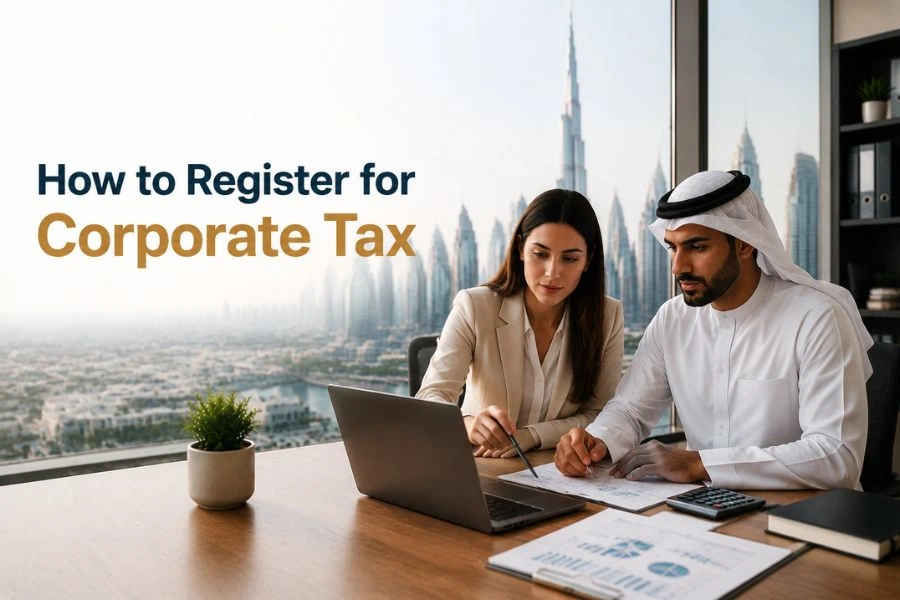
Every business must register for Corporate Tax on the EmaraTax portal, even if you are exempt or qualify for 0%. Not registering is itself a penalty.
The penalty for late registration is AED 10,000. However, the FTA has run an initiative to waive this penalty for businesses that catch up and file their first return within seven months of their first tax period ending.
Registration deadlines depend on when your trade licence was issued. For new businesses (licence after March 1, 2024), you must register within three months of incorporation.
Corporate Tax Filing Deadlines
You must file your Corporate Tax return within nine months of your financial year-end. Payment is due at the same time.
Examples:
• Financial year ends December 31, 2024 → File and pay by September 30, 2025
• Financial year ends March 31, 2025 → File and pay by December 31, 2025
• Financial year ends December 31, 2025 → File and pay by September 30, 2026
Missing the deadline costs you AED 500 per month for the first 12 months and AED 1,000 per month after that.
How Is Corporate Tax Calculated?
You start with your accounting profit from your financial statements. Then you make adjustments as required by UAE tax guide for businesses law. Common adjustments include:
• Interest limitation: You can only deduct net interest up to 30% of your EBITDA
• Unrealized gains/losses: Generally excluded unless you opt in
• Participation exemption: Dividends and capital gains from qualifying subsidiaries may be exempt
• Loss carry-forward: Losses can offset up to 75% of taxable income in future years
This is where proper bookkeeping matters. If your records are not clean, calculating the right tax is hard. Errors lead to penalties.
Transfer Pricing Rules
If your business does transactions with related companies (parent, subsidiary, or sister companies), these must be priced at arm’s length. This means the same price you would charge an unrelated third party.
You need a Transfer Pricing Policy. You also need a benchmarking study to prove your prices are fair. Review this policy at least every three years.
Large groups also need to file a Master File and Local File. The FTA can request these during an audit.

Part 3: Excise Tax in the UAE
Excise Tax targets products that are harmful to health or the environment. The UAE introduced it in 2017.
The current rates are:
• Tobacco products: 100%
• Energy drinks: 100%
• Carbonated drinks: 50%
• Electronic smoking devices: 100%
• Liquids used in such devices: 100%
• Sweetened drinks: 50%
Excise Tax is paid by importers and producers, not by the end consumer directly. But the cost is passed on through higher prices. If your business imports or produces any of these products, you must register for Excise Tax with the FTA.
Part 4: Other Taxes and Fees in the UAE
No Personal Income Tax
The UAE does not charge personal income tax. Salaries, bonuses, and wages are all tax-free. This applies to both UAE nationals and expatriates. It is one of the biggest reasons people choose to live and work here.
No Capital Gains Tax
There is no personal capital gains tax in the UAE. If you sell a property or an investment for a profit, you do not pay tax on that gain personally. However, if a company earns capital gains as part of its business, those are subject to Corporate Tax.
Customs Duties
The UAE charges customs duty of 5% on most imported goods. Some products like alcohol and tobacco face higher rates. Goods traded within the GCC (Gulf Cooperation Council) often face no duty. Free Zones are typically customs-free zones, but goods moved from a Free Zone into the mainland UAE are subject to customs duty.
Municipal Fees and Tourism Dirham
Each emirate charges its own municipal fees. In Dubai, hotels charge a Tourism Dirham fee per room per night. Restaurants in some areas pay a municipality fee on food and drink sales. These are not federal taxes but they are real costs for businesses in hospitality.

Part 5: How to Stay Compliant 8 Practical Steps
Compliance is not just about filing on time. It is about having the right systems in place all year. Here are eight steps every UAE business should follow:
6. Register for all applicable taxes immediately. Do not wait. Late registration is expensive.
7. Keep all invoices and receipts. The FTA requires you to keep records for five years (15 years for real estate businesses).
8. Use accounting software. Manual records are risky. Software reduces errors and makes filing easier.
9. Reconcile your VAT return with your financial statements. The FTA compares these. Differences cause questions.
10. Prepare audited financial statements. Required for Corporate Tax filing. Also required if your revenue exceeds AED 50 million.
11. Review your Free Zone status every year. QFZP conditions can change. One year of non-compliance costs you the 0% rate.
12. Train your finance team. UAE tax law is new and still evolving. Keep your team updated.
13. Work with a registered tax agent. A qualified tax consultant saves you time and money. They know the rules. They keep you safe.
Frequently Asked Questions About UAE Business Taxes
Is the UAE really tax-free for businesses?
No. The UAE is not completely tax-free. There is no personal income tax. But businesses now pay Corporate Tax (9% above AED 375,000) and VAT (5%). Certain goods also face Excise Tax. The UAE is still one of the most tax-friendly countries in the world, but ‘tax-free’ is no longer fully accurate for businesses.
Do I need to register for Corporate Tax if I am in a Free Zone?
Yes. Every business in the UAE must register for Corporate Tax, including Free Zone companies. You may qualify for a 0% rate as a QFZP, but registration itself is mandatory. Not registering results in a penalty of AED 10,000.
What happens if I miss the VAT filing deadline?
The FTA charges a late filing penalty of AED 1,000 for the first violation and AED 2,000 for each subsequent violation. You also pay a late payment penalty of 2% of the unpaid tax immediately. An additional 4% monthly penalty applies if the tax is still unpaid after seven days.
Can I carry forward losses to reduce future Corporate Tax?
Yes. You can carry forward tax losses to future years. But you can only use them to offset up to 75% of your taxable income in any given year. You cannot carry losses back to previous years.
Do freelancers and sole traders pay Corporate Tax?
Freelancers and individuals who run a business only pay Corporate Tax if their annual business turnover exceeds AED 1 million. If your income is below that threshold, Corporate Tax does not apply to you as an individual. However, if your business is incorporated as a company, the standard Corporate Tax rules apply regardless of turnover.
What is EmaraTax?
EmaraTax is the FTA’s online portal. You use it for everything: registering for VAT, registering for Corporate Tax, filing returns, making payments, and requesting refunds. Every business that has any tax obligation in the UAE needs an EmaraTax account.
How does VAT work for e-commerce businesses in the UAE?
E-commerce businesses follow the same VAT rules as physical businesses. If your taxable supplies exceed AED 375,000 per year, you must register for VAT. You charge 5% VAT on sales to UAE customers. For international sales, the goods may be zero-rated if they are exported. Non-resident businesses selling digital services to UAE consumers may also need to register for VAT.
Final Thoughts: UAE Tax Is Manageable With the Right Help
The UAE tax system is newer than in most countries. Rules are still being updated. New decisions from the FTA come out regularly. This makes it hard to keep up if you are running a business full-time.
The good news: UAE taxes are still low compared to most of the world. A 9% Corporate Tax rate is far below the global average of around 23%. VAT at 5% is lower than almost every other country with a VAT system.
The risk is not the tax itself. The risk is getting it wrong. Penalties for late registration, late filing, and errors add up fast. Many businesses pay far more in fines than in actual tax.
The smartest move is to work with a qualified tax consultant who knows the UAE system inside out. They keep you compliant, save you time, and often reduce your tax bill legally.
Need help with VAT or Corporate Tax in the UAE?
Abu Areeb Accounting & Tax Consultants provides VAT registration, Corporate Tax filing, bookkeeping, and audit services across the UAE. Our team of qualified accountants and tax advisors has helped hundreds of businesses stay compliant and reduce tax costs.
Book a free consultation today. Visit abuareeb.com or call us to speak with a UAE tax expert.